
🩶
For a new parent of a 3-month-old African Grey parrot
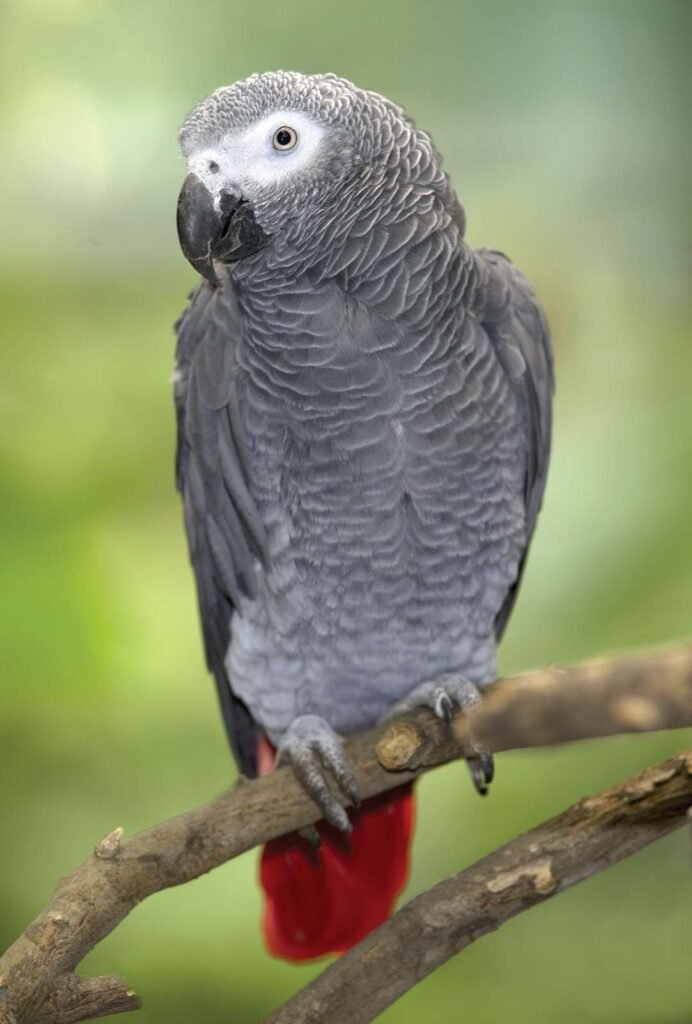
Your African Grey is not a miniature adult yet. At approximately 3 months, he is still developing physically, learning how to eat independently, discovering his environment and learning whether humans and his new home are safe.
African Greys are exceptionally intelligent and sensitive parrots. Routine, good nutrition, gentle socialisation and mental stimulation from the beginning can have a major influence on their long-term health and behaviour. (Lafeber Company)
1. FIRST QUESTION: IS YOUR BABY FULLY WEANED?
At 3 months, do not automatically assume that an African Grey is completely weaned.
African Grey weaning varies considerably between individuals. Veterinary references place weaning around this general developmental period, but specifically caution against deciding that a bird is weaned simply because it has reached a certain age. (Lafeber Company)
A fully weaned baby should:
- Eat adequate solid food independently.
- Drink independently.
- Maintain a stable body weight.
- Produce regular droppings.
- Not depend on hand-feeding to maintain nutrition.
If he is still receiving formula:
Do not suddenly stop formula to make him hungry enough to eat solids.
Weaning should happen gradually as the baby increasingly eats pellets and fresh foods independently. Monitor his weight every day during this stage. (Vca)
Important: Hand-feeding has risks including aspiration, crop burns and crop problems. The Association of Avian Veterinarians opposes transferring unweaned birds to inexperienced people for this reason. If your baby still requires formula, get an avian veterinarian or experienced professional to guide you. (MSD Veterinary Manual)
2. TEMPERATURE
For a fully feathered/weaned young parrot, approximately 24–29°C is a reasonable environmental range. General household temperatures around 21–27°C are also considered acceptable for healthy African Greys. (MSD Veterinary Manual)
Your room is currently 32°C
That is warmer than ideal for routine indoor housing.
Try to bring it gradually closer to approximately 26–29°C if possible.
Do:
- Provide good ventilation.
- Keep the cage out of direct sunlight.
- Keep fresh water available.
- Provide shade.
- Allow bathing/misting if he enjoys it.
- Use AC if required, but cool the room gradually.
Avoid:
- Direct AC blowing onto the bird.
- A fan blowing continuously at him.
- Sudden large temperature changes.
- Heavy cage covers that trap heat.
Watch for panting, open-beak breathing or wings held away/drooping from the body, which can indicate overheating. (Vca)
A humidity level around 40–50% is suitable for many companion birds. (Vca)
3. FOOD: BUILD GOOD HABITS NOW
African Greys can become selective eaters. A seed-heavy diet is particularly undesirable because African Greys are vulnerable to nutritional deficiencies, including calcium problems. (Lafeber Company)
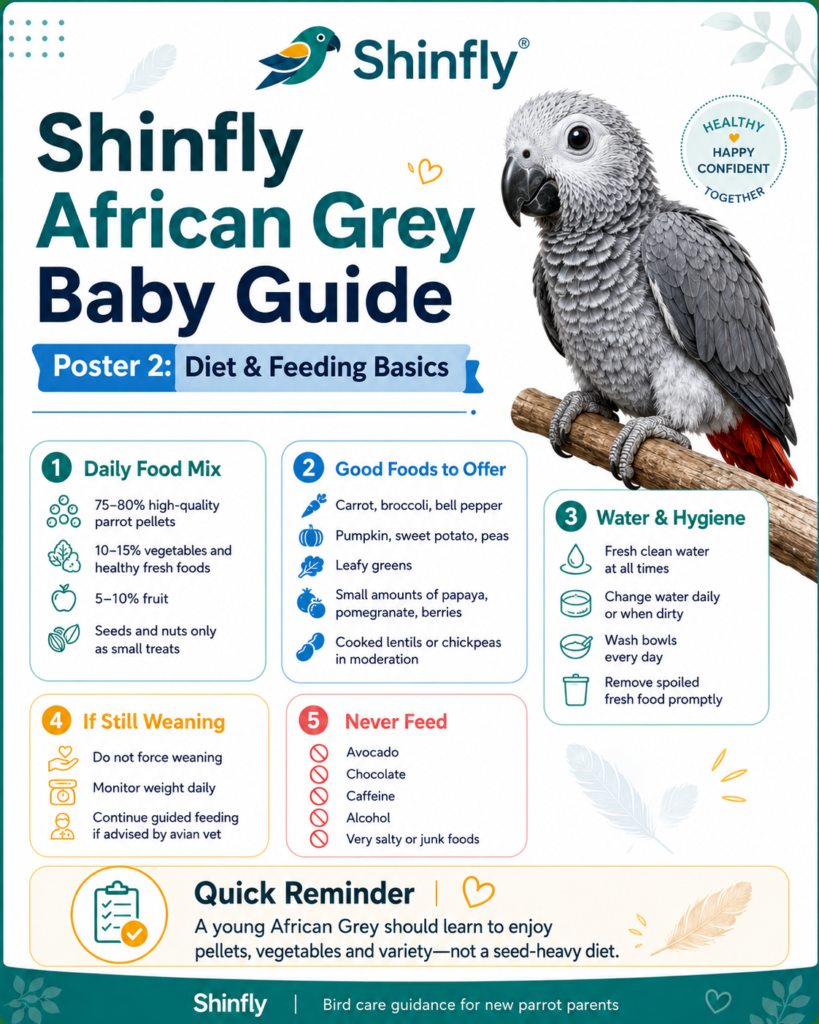
Once reliably weaned, aim approximately for:
≈ 75–80% nutritionally complete parrot pellets
≈ 10–15% vegetables and healthy fresh foods
≈ 5–10% fruit
Seeds and nuts should mainly be used as small treats and training rewards, rather than being the main diet. (MSD Veterinary Manual)
Excellent foods to introduce while young
Offer variety:
Vegetables
- Carrot
- Bell pepper
- Broccoli
- Pumpkin
- Sweet potato — cooked
- Squash
- Peas
- Leafy greens
Other healthy foods
- Cooked lentils
- Cooked chickpeas
- Small amounts of cooked brown rice
Fruit — small portions
- Papaya
- Mango
- Pomegranate
- Berries
- Melon
- Banana
Fresh foods should be washed thoroughly. Fruit should remain the smaller component because of its sugar content. (Vca)
Never make sunflower seeds or peanuts his staple food.
A bird offered a mixed bowl may simply select its favourite high-fat seeds and leave the nutritious foods behind. (Vca)
4. FOODS TO KEEP AWAY
Never offer:
- ❌ Avocado
- ❌ Chocolate
- ❌ Alcohol
- ❌ Coffee, tea or other caffeinated drinks
- ❌ Very salty foods
- ❌ Fried foods
- ❌ Highly processed/junk foods
(Vca)
Supplements
Do not automatically add calcium, vitamin D, multivitamins or other supplements simply because African Greys can develop calcium problems.
A Grey eating an appropriately formulated pellet-based diet generally should not routinely require additional supplementation unless an avian veterinarian identifies a reason for it. (Vca)
5. WATER
Fresh, clean drinking water must always be available.
Change it at least daily and sooner whenever food or droppings contaminate it.
Wash food and water bowls every day. (Vca)
6. CAGE SETUP
African Greys need substantially more space than small parrots.
A useful minimum cage guideline for an African Grey is approximately:
90 cm × 90 cm × 120 cm
Larger is preferable whenever practical. (Vca)
Recommended bar spacing is approximately:
1.9–2.5 cm
Inside the cage provide:
- Several safe natural-wood perches of different diameters.
- A stable sleeping perch.
- Separate food and water stations.
- Chewing toys.
- Shredding toys.
- Beginner foraging toys.
- Climbing opportunities.
Avoid filling every centimetre with toys. Your baby needs enough open space to move and stretch comfortably.
Introduce unfamiliar toys gradually. African Greys can be cautious about new objects. (Lafeber Company)
Avoid sandpaper/grit perches.
African Greys do not require grit, and ingestion can create serious gastrointestinal problems. (Vca)


7. SLEEP
Your baby needs a predictable day/night rhythm.
Aim for approximately:
🌙 12 hours of quiet darkness
☀️ 12 hours of normal daytime activity/light
A consistent sleep routine is preferable to keeping him awake late every night with television, conversation and household activity. (Vca)
8. BONDING: DON’T RUSH HIM
The first objective is trust, not talking and not performing tricks.
For the first several days:
- Sit near the cage.
- Speak softly.
- Allow him to watch you.
- Offer favourite foods by hand if he is comfortable.
- Avoid repeatedly grabbing or chasing him.
- Let him choose to approach.
African Greys are intelligent but can also be cautious about changes. (Lafeber Company)
Begin teaching:
Step up
“Step up” onto your hand or a handheld perch.
Step down
Target training
Come/recall once his flight skills and confidence develop safely.
Use tiny food rewards and praise.
Training sessions can be short—several positive minutes are far better than continuing until the baby becomes tired or frustrated.
9. DON’T CREATE A “ONE-PERSON BIRD”
African Greys can become strongly attached to a single person if they are not appropriately socialised. (Lafeber Company)
From babyhood, calmly expose him to:
- Different family members.
- Different voices.
- Men and women.
- Normal household sounds.
- Different safe rooms.
- His transport carrier.
- Gentle examination of feet and wings.
- New toys and foods.
Never overwhelm him. Introduce experiences gradually and positively.
10. TALKING & LEARNING
Do not worry if your 3-month-old does not speak yet.
Instead, build communication:
Morning:
“Good morning!”
Food:
“Want breakfast?”
Water:
“Water.”
When approaching:
“Hello!”
Bedtime:
“Good night.”
Use the same words consistently. African Greys are highly capable vocal learners, but individual birds develop speech differently and some may speak much more than others. (Vca)
11. MENTAL ENRICHMENT IS NOT OPTIONAL
African Greys require significant mental stimulation. Lack of appropriate stimulation and sudden changes in routine can contribute to behavioural problems, including feather-damaging behaviour. (Lafeber Company)
Every day provide a combination of:
🧩 Foraging — make him search for some food.
🪵 Chewing — bird-safe wood and shredding materials.
🎓 Learning — simple positive-reinforcement training.
🗣️ Social interaction — talk, whistle and spend time together.
🛁 Bathing — offer regular opportunities; African Greys produce significant powder down. (Lafeber Company)
Do not simply leave a Grey inside a cage surrounded by toys all day. Interaction and opportunities to perform normal parrot behaviours matter. (AAV)
12. THE MOST IMPORTANT PURCHASE: A GRAM SCALE
Buy a digital scale that measures in 1-gram increments.
At this age, particularly during weaning:
Weigh him every morning at approximately the same time.
Keep a diary:
Date | Weight | Food eaten | Droppings | Behaviour | Notes
Weight trends are much more useful than guessing whether a young bird “looks thin.”
Young birds should be monitored carefully through weaning, and unexplained poor weight gain or weight loss requires veterinary assessment. (Vca)
13. FIRST AVIAN-VET VISIT
A newly acquired bird should ideally be examined by an avian veterinarian within the first few days.
The visit provides a baseline weight, physical examination and an opportunity for the veterinarian to recommend appropriate screening based on the bird’s history. (Vca)
Bring:
- Breeder/seller records
- Hatch date
- Current diet
- Hand-feeding history
- Previous medications
- Any laboratory reports
- DNA-sexing certificate, if available
- Photos of recent droppings
- Your weight records
Is he definitely male?
African Greys are sexually monomorphic, meaning males and females cannot be reliably distinguished simply by ordinary external appearance. If the sex has not already been confirmed, discuss DNA sexing with your avian veterinarian. (Lafeber Company)
14. IF YOU HAVE OTHER BIRDS AT HOME
Do not immediately place the new African Grey with your existing flock.
New birds should first receive veterinary examination. Veterinary guidance commonly recommends an initial quarantine period in a separate area before introduction to resident birds. (Vca)
Never house an African Grey in the same cage as much smaller birds such as budgies.
15. MAKE YOUR HOME “BIRD-AIR SAFE”
This is one of the most important rules for a new parrot household.
Birds have exceptionally sensitive respiratory systems.
Keep your Grey away from:
- ❌ PTFE/Teflon/non-stick cookware fumes
- ❌ Cigarette or cigar smoke
- ❌ Vaping
- ❌ Essential-oil diffusers
- ❌ Aerosol sprays
- ❌ Air fresheners
- ❌ Strong cleaning fumes
- ❌ Paint and varnish fumes
- ❌ Smoke from overheated cookware
Overheated PTFE/non-stick coatings can cause extremely serious or even rapidly fatal poisoning in birds. (Vca)
Do not keep his main cage in the kitchen.
16. OTHER HOME DANGERS
Before allowing free flight, check:
- Ceiling fans are OFF.
- Windows and external doors are secured.
- Mirrors/glass are recognised or covered during early flight learning.
- Electrical cables cannot be chewed.
- Open toilets are closed.
- Buckets and deep containers of water are inaccessible.
- Cats and dogs never have unsupervised access to him.
(Vca)
17. KNOW WHAT NORMAL LOOKS LIKE
Every day notice:
Healthy signs
✅ Alert and interested
✅ Strong grip
✅ Eating regularly
✅ Normal vocalisation
✅ Preening
✅ Smooth breathing with closed beak at rest
✅ Regular droppings
✅ Stable weight trend
✅ Interested in his surroundings
Learn your own bird’s normal, because changes from his baseline can be more informative than comparing him with another parrot.
18. RED FLAGS — CONTACT AN AVIAN VET
Seek veterinary advice promptly for:
🚨 Open-mouth or laboured breathing
🚨 Tail moving strongly up and down with each breath
🚨 Sitting persistently fluffed and inactive
🚨 Remaining on the cage floor
🚨 Sudden inability to perch
🚨 Refusing food
🚨 Significant or unexplained weight loss
🚨 Repeated vomiting/regurgitation associated with illness
🚨 Major change in droppings
🚨 Weakness or poor coordination
🚨 Seizure/tremors
🚨 Drooping wings or abnormal posture
(Vca)
For a baby still being hand-fed, also treat these seriously:
- Weak feeding response
- Crop failing to empty normally
- Failure to gain/maintain weight
- Food/wetness over the crop
- Abnormal wing or leg position
(Vca)
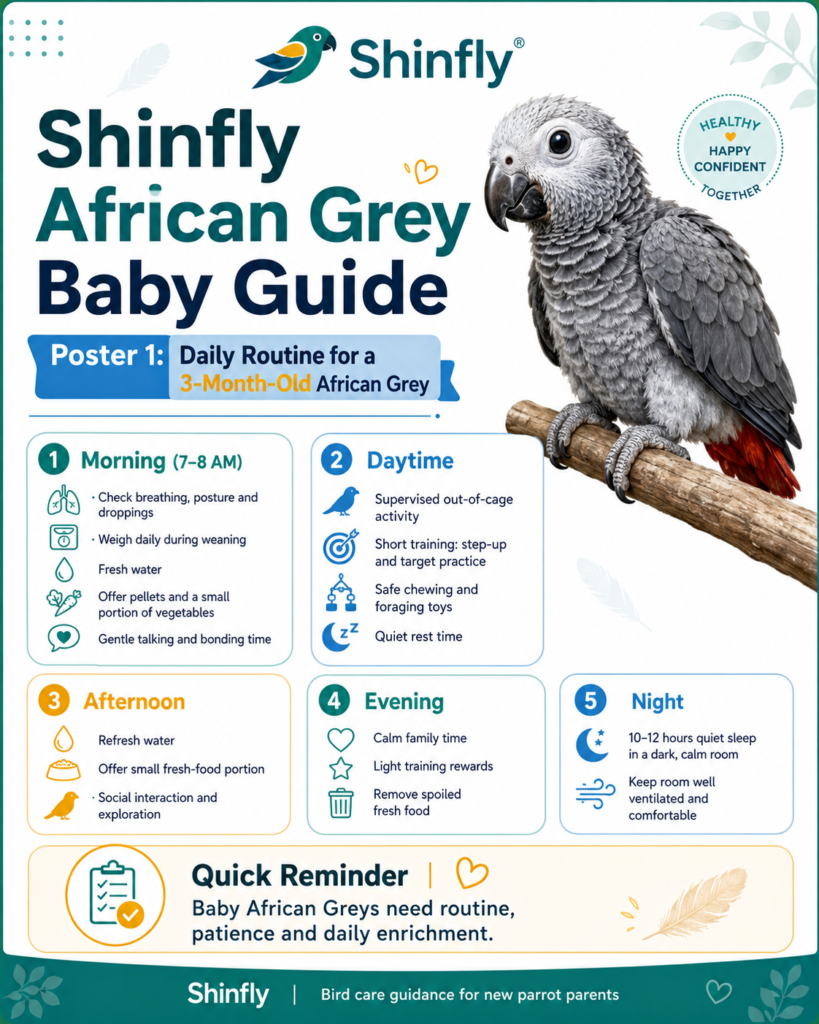
19. SIMPLE DAILY ROUTINE
🌅 Morning
7:00–8:00
- Wake up.
- Check appearance and breathing.
- Morning weight during weaning.
- Fresh water.
- Pellets/breakfast.
- Fresh vegetables.
- Social interaction.
☀️ Morning–Afternoon
- Safe out-of-cage activity.
- Short training session.
- Foraging.
- Independent play.
- Quiet/rest period.
🌤️ Afternoon
- Refresh water.
- Small fresh-food offering.
- Interaction/training.
- Supervised exploration.
🌆 Evening
- Family/social time.
- Calm activities.
- Small training rewards rather than a bowl of nuts/seeds.
🌙 Night
- Remove spoiled fresh food.
- Check water.
- Quiet environment.
- Approximately 12 hours uninterrupted darkness/rest.
20. YOUR FIRST-WEEK CHECKLIST
- Confirm whether the baby is completely weaned.
- Buy a 1-g digital gram scale.
- Begin a daily weight diary.
- Arrange an avian-veterinarian examination.
- Confirm current diet with breeder/seller.
- Introduce a high-quality formulated pellet appropriately.
- Introduce several vegetables.
- Provide fresh water continuously.
- Set up a large, safe cage.
- Provide natural perches.
- Add chewing and beginner-foraging toys.
- Establish approximately 12 hours of nighttime darkness.
- Check the home for PTFE/non-stick risks.
- Remove smoke, fragrances and aerosol exposure.
- Begin gentle step-up training.
- Socialise gradually with more than one trusted person.
- Learn his normal droppings, behaviour and appetite.
- Keep your avian veterinarian’s number accessible.
THE FIVE GOLDEN RULES
1. Never force-wean a baby African Grey.
2. Never make seeds the primary diet.
3. Never expose a parrot to PTFE/Teflon fumes or smoke.
4. Weigh a young Grey regularly rather than judging health by appearance.
5. Build trust, independence and enrichment from the very beginning.
A 3-month-old African Grey is learning how to be a parrot and how to live with humans at the same time. The objective during these early months is not simply to create a tame or talking bird—it is to develop a physically healthy, emotionally secure, curious and confident companion.
References
Hess, L. (2026). Lung and airway disorders of pet birds. MSD Veterinary Manual.
Hoppes, S. M. (2024). Management of pet birds. MSD Veterinary Manual.
Hoppes, S. M. (2026). Pediatric diseases of pet birds. MSD Veterinary Manual.
Pollock, C. (2012, January 7). Basic information sheet: African grey parrot. LafeberVet.
Rich, G., Axelson, R., & Hess, L. (2023, August 23). Introducing a new pet bird. VCA Animal Hospitals.
Rich, G., Axelson, R., & Hess, L. (2024, March 5). Housing large birds. VCA Animal Hospitals.
Rich, G., Axelson, R., & Hess, L. (2024, March 20). Hand-feeding baby birds. VCA Animal Hospitals.
Rich, G., Axelson, R., & Hess, L. (2022, May 24). African Grey parrots—Feeding. VCA Animal Hospitals.
Rich, G., & Axelson, R. (2026, April 10). Taming, training, and talking to birds. VCA Animal Hospitals.
Schmid, R., Brutlag, A., & Axelson, R. (2025, July 23). Household hazards and dangers to birds. VCA Animal Hospitals.
